Much of what is sold under this name has been tested. Some of it held up.
Buyers now ask ChatGPT, Perplexity and Google's AI answers the questions they used to type into a search box. The answer names a few companies, and the buyer starts from that short list.
So a new kind of work has a name, answer engine optimization, and a crowd of tactics sold under it. Special files for AI crawlers, schema, rewrites "for AI", rank trackers.
Several of those tactics have been put through controlled tests and large studies. This guide covers what answer engine optimization is, what the published research supports, what it does not, and how to measure whether any of it is working for you. The method is the Magnetiz Answer Engine Optimization Playbook, with a worksheet for each step.
What is answer engine optimization?
Answer engine optimization is the work of getting your company named or cited when someone asks an AI answer engine a question you can answer. The engines include ChatGPT, Perplexity, Gemini, Claude, Copilot, and Google's AI Overviews and AI Mode.
The unit of work is the question. An engine names a company in reply to something a person asked, so a page only helps if it answers a question buyers really ask.
Two outcomes matter, and they are different. An answer can cite your page as a source, and an answer can name your company in its text. Semrush and Kevin Indig tracked more than 50,000 brands in ChatGPT and found that only 21% of the most-cited domains were also the most-mentioned brand (Semrush topic authority study).
Being named is the win. Being cited is useful and is counted separately.
Watch for a report that adds citations and mentions into one visibility number. The two can move in opposite directions.
What is the difference between answer engine optimization, generative engine optimization and SEO?
Answer engine optimization and generative engine optimization are two names for the same work, and both build on SEO without replacing it. People search for both names. In Google's AI answers in the US, "generative engine optimization" draws about 4,400 questions a month and "answer engine optimization" about 2,400 (DataForSEO, pulled November 10, 2026).
SEO earns a position on a results page. Answer engine optimization earns a place inside a written answer, where there are no positions and the companies named change from one run to the next.
Ranking in classic search still helps. How much depends on the engine.
In July 2025, Semrush found that the domains an engine cites overlap with Google's top 10 more than 91% of the time for Perplexity, about 86% for AI Overviews, about 54% for AI Mode and about 45% for ChatGPT. Ahrefs reran its own study in 2026 across 863,000 results pages and found 37.9% of AI Overview citations came from top-10 pages (Ahrefs).
So a page that ranks has a better chance, and a page that ranks is still far from guaranteed a citation.
Watch for anyone who says SEO is finished, and anyone who says nothing has changed. The research supports neither.
How does answer engine optimization work?
It works by becoming one of the sources an engine already trusts for a specific question, either through your own page or through other people's pages that name you. Engines draw on two things, what the model remembers from training and what it finds when it runs a live search.
Live search is the smaller part for ChatGPT. Ahrefs analysed 66.6 million logged-out ChatGPT responses and found only 14.4% ran a web search at all (Ahrefs fan-out study). The rest came from the model's memory of the web.
When ChatGPT does search, the kind of question decides whose pages it uses. For factual questions about a company, 63.4% of citations went to official sites. For comparison questions, that fell to 46.4%, with third parties carrying more of the answer.
That gives a small firm two jobs. Your own site has to answer the factual questions about you plainly. Other sites, lists and videos have to mention you for the comparison questions.
The source mix also moves. ChatGPT's sources shifted in September 2025, in July 2026 and again in August and September 2026. Reddit went from about 1 in 5 US answers in March 2026 to about 1 in 43 by late September.
Watch for a tactic that depends on one engine's habits this month. It has a short life.
How do you do answer engine optimization?
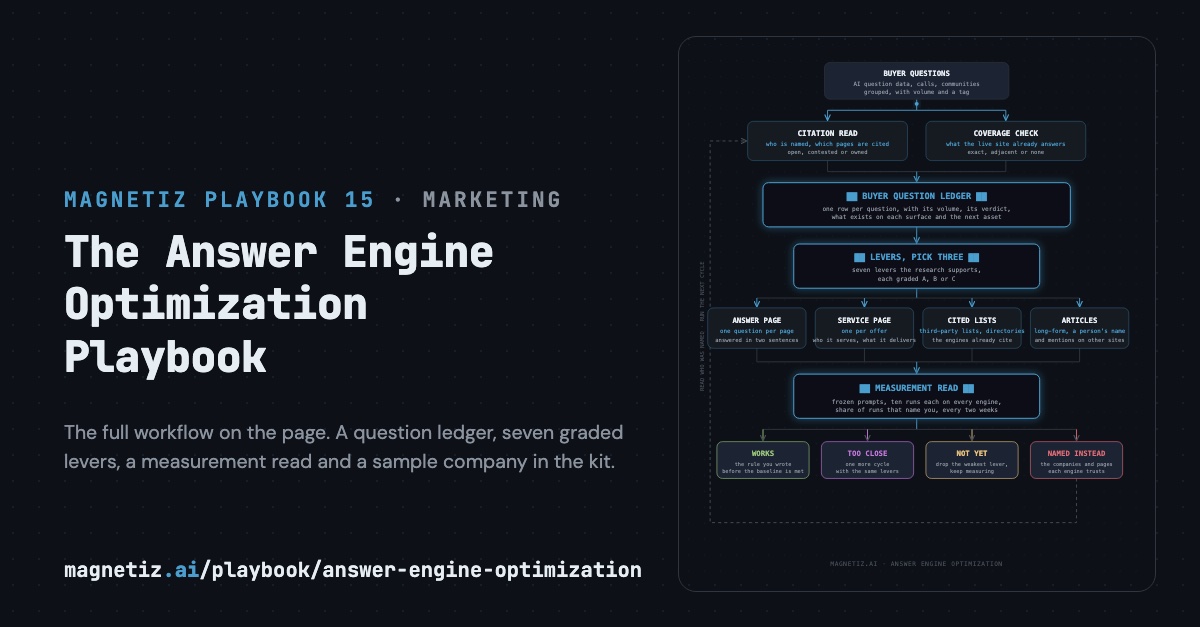
Work one question at a time, in six steps, and set up the measurement before the first page ships. Each step has a worksheet in the playbook.
- Pull the questions buyers ask. Use AI question data, sales calls, community threads and your own search queries. Group the phrasings that are one question, add their volumes, and tag who is asking. A tool shopper and a job seeker are different readers from a buyer.
- Read who gets cited. Ask each question on at least two engines, three times each, in a fresh session. Log the companies named, the domains cited and the shape of the answer. Then sort each question as open, contested or owned.
- Check what you have already published. Search your own site before writing anything. A question list makes every row look like new work, and an older page may already answer it. We made this mistake ourselves, and the coverage check exists because of it.
- Pick levers the research supports. Choose at most three for the first eight weeks. With more than three you cannot tell which one moved the read.
- Write one answer per question. Put the question in a heading, answer it in the first two sentences, state specific numbers with their source and date, and serve the page as plain HTML.
- Measure the share of answers that name you. Freeze the prompts, run each one many times on each engine, and read again every two weeks.
When a broad question is owned by large brands, look for the narrow one underneath it. Add the platform, the company size or the task. "Lead scoring" becomes "hubspot lead scoring".
See all six steps in the playbook →
Watch for a plan that starts at step 5. Writing first is how a team ends up with a second page on a question it had already answered.
What is the best answer engine optimization strategy for a small company?
Pick narrow questions where few sources exist, and become one of the sources. That is the lever with the strongest evidence for a company without a large brand.
Ahrefs tested it with a real intervention in 2026. It published 34 pages promoting a brand-new name and tracked 9,886 answers across ChatGPT, Gemini, Perplexity and Copilot. The new name appeared in 66.4% of answers to a narrow question and 15.8% of answers to a broader one (Ahrefs experiment).
Most questions are still open. Semrush tracked 1,094 categories in ChatGPT for six months. Only 15.2% had a clear owner and 53.7% were unsettled. Clear owners then held first place in 90.4% of month-over-month comparisons, so being early in a narrow category is worth a great deal.
Five more levers reach a small firm.
- One plain service page per offer. For agency questions, the agency's own service pages were the most-cited first-party page type at 30.4% (Ahrefs, 750 prompts).
- Third-party lists and directories the engines already cite. Lists of "best X" were 43.8% of cited page types, and 35% of the cited lists sat on low-authority domains (the same Ahrefs study).
- Practical long-form articles on LinkedIn under a person's name. Long-form articles were 50 to 66% of cited LinkedIn content, and authors with under 500 followers were cited about as often as larger ones (Semrush with LinkedIn data, 89,000 URLs).
- Mentions on many independent sites and videos. Across 75,000 brands, mentions in YouTube videos correlated with AI visibility at about 0.74 and mentions on other sites at 0.66 to 0.71. Domain rating came in at 0.27 to 0.33 (Ahrefs).
- Specific numbers, named sources and dates on the page. Pages cited by AI assistants averaged about 26% newer than organic results across 17 million URLs (Ahrefs).
One caution belongs beside every item. Almost all of these studies were run by companies that sell a tracking tool, on brands far larger than a small firm. None tested a small B2B services company. Treat the levers as the best available bets, and measure your own result.
Watch for the mentions finding quoted as a cause. It is a correlation in a sample of well-known brands.
Which answer engine optimization tactics does the research not support?
The research found no lift from llms.txt files, from schema added to win AI citations, or from rewriting pages "for AI". Each of these has a controlled test or a large study behind the finding.
| Tactic | What was found |
|---|---|
| An llms.txt file | No correlation with citations across about 300,000 domains (SE Ranking). Google's guide says Search ignores the file |
| Schema added for AI citations | 1,885 pages added JSON-LD, each matched to three controls. No lift (Ahrefs, 2026) |
| Rewriting pages "for AI" | A 2025 NeurIPS benchmark found most rewrite methods do little, and that where a page ranks in retrieval matters far more (C-SEO Bench) |
| Tracking your "rank" in an answer | The same order of brands repeated under 0.1% of the time across 2,961 runs (SparkToro and Gumshoe) |
| A "best X" list with yourself first | In 43% of answers that cited a planted page, the engine recommended a competitor from that page (the Ahrefs experiment) |
The claim of "up to 40% more AI visibility" from content edits traces to a lab benchmark. Aggarwal and colleagues found that adding quotations raised a source's share of an answer by 42.6% and adding statistics by 32.8% (GEO, KDD 2024). The engine in that test was GPT-3.5 in 2023, and the pages had already been retrieved.
Google says the same in its own AI optimization guide. It states that no special schema is needed, that content need not be chunked, and that "you don't need to write in a specific way just for generative AI search."
Schema still earns its place for normal search features. The test only found no lift in AI citations.
Watch for a proposal built mainly from the left column of that table. Those hours buy very little.
Which answer engine optimization tools do you need?
You need two things from a tool, the questions people ask with their volumes, and clean repeated runs of your own prompts. A spreadsheet covers the rest.
Several products provide AI question data, among them DataForSEO's LLM Mentions, Ahrefs Brand Radar, the Semrush AI Visibility Toolkit and Profound. We name them as options and recommend none of them over the others.
Whatever you choose, check four things.
- It shows the real questions and the pages cited for each. A score with no questions under it cannot guide a page.
- It runs each prompt many times. One run per prompt is an anecdote.
- It separates named from cited. They are different outcomes.
- It runs logged out, with web search on. A logged-in account carries the memory of your past chats.
Read the volumes as a floor. AI question data describes one engine's logged questions, usually Google's AI answers in one country, and it only returns questions that contain your seed phrase. An empty result does not mean nobody asks.
Watch for a dashboard that reports your position in ChatGPT. The research found positions do not repeat.
Should you hire answer engine optimization services or an agency?
Hire help when you lack the hours for the question list, the pages and the outreach, and judge a provider by how it measures. The method itself is public, and a small team can run the first cycle alone.
Many people are asking. "Answer engine optimization services" and "generative engine optimization services" each draw about 590 questions a month in the same data, and the agency phrasings add several hundred more.
Five questions sort the providers.
- Which questions will you target, and where did they come from?
- How many times do you run each prompt, on which engines, and are the prompts frozen?
- Do you report the share of answers that name us, with a range, separately from citations?
- What did the baseline read before any work began?
- Which tactics will you leave out, and why?
A provider whose plan leans on llms.txt, schema for AI or a guaranteed position is selling the tactics the research did not support.
Watch for a case study built on a screenshot of one answer. Ask how many runs it came from.
How do you measure answer engine optimization?
Measure the share of runs in which an answer names you, across many runs of the same frozen prompts. A single answer tells you nothing, because the companies an engine names change every time you ask.
SparkToro and Gumshoe ran 12 recommendation prompts 2,961 times on ChatGPT, Claude and Google's AI. The same list of brands came back under 1% of the time. Share of appearances across many runs held much steadier.
Set it up before the first page ships.
- Freeze the prompts. Take the questions word for word and never edit one after the baseline. Adding a new prompt later is fine.
- Write the rule first. Decide what "it worked" means before you see a number. A starting point to test is being named in at least 20% of runs on at least two engines.
- Run each prompt at least 10 times on each engine. Then read the family of prompts, where the runs add up to a hundred or more.
- Record named and cited separately, along with who was named in your place and which domains were cited.
- Show a range. Zero named in 140 runs still leaves a true rate anywhere from 0% to about 2%.
- Read again every two weeks, and log anything else that could have moved the number, such as an engine changing its model.
We run this on ourselves, and our own baseline on October 30, 2026 read zero, with 27 questions asked on four engines and 799 answers counted.
A zero baseline is the normal start for a small firm. It still tells you which companies the engines trust for your buyers' questions and which pages they cite.
Watch for a rate that rests on one prompt out of ten. That is one lucky question.
The pattern across answer engine optimization that holds up
Every step above comes back to one question, whether an engine names you when a buyer asks. The question list tells you where to look. The citation read tells you which questions a company your size can win. The coverage check stops you answering the same question twice.
The levers are bets, graded by how strong their evidence is. The measurement is what turns a bet into a result you can show.
The playbook holds a worksheet for each step, free by email. It covers the question list, the citation read, the coverage check, the levers and their evidence, the answer page brief, the measurement read, and a worked example for a made-up company.
Get the playbook and the kit →
An answer engine names the sources it trusts for a question. Pick the question, earn the trust, and count how often you are named.
FAQ
What is answer engine optimization?
Answer engine optimization is the work of getting a company named or cited when someone asks an AI answer engine a question. The engines include ChatGPT, Perplexity, Gemini, Claude, Copilot and Google's AI Overviews. Answer engine optimization works one question at a time. It counts an answer that names you as the win and tracks citations separately.
Is answer engine optimization the same as generative engine optimization?
Yes. Answer engine optimization and generative engine optimization describe the same work under two names, and people search for both. In Google's AI answers in the US, "generative engine optimization" draws about 4,400 questions a month and "answer engine optimization" about 2,400. Use whichever name your buyers use.
Does SEO still matter for answer engine optimization?
Yes. Ranking in classic search still raises the chance of being cited, most for Perplexity and Google's AI Overviews and least for ChatGPT. Ahrefs found in 2026 that 37.9% of AI Overview citations came from top-10 pages. SEO helps answer engine optimization and does not guarantee a citation.
Do llms.txt and schema help with answer engine optimization?
The research found no lift from either. SE Ranking found no correlation between an llms.txt file and citations across about 300,000 domains, and Google says Search ignores the file. Ahrefs tested 1,885 pages that added schema against matched controls and found no lift in AI citations. Schema remains useful for normal search features.
What is the best answer engine optimization strategy for a small company?
The best-supported answer engine optimization strategy for a small company is to pick narrow questions where few sources exist. In a 2026 Ahrefs experiment, a brand-new name appeared in 66.4% of answers to a narrow question and 15.8% to a broader one. Add a plain service page per offer and get onto the third-party lists the engines already cite. Then measure your own result, since no study has tested a small B2B services firm.
How do you measure answer engine optimization?
Measure answer engine optimization by the share of runs in which an answer names your company. Freeze a set of prompts, run each at least 10 times on each engine, and read the result as a rate with a range. Record named and cited separately. Read again every two weeks against a rule you wrote before the baseline.