In McKinsey’s 2026 State of AI survey of 1,719 respondents, 80% said AI has improved their own productivity.
Only 37% said AI has contributed anything to their organization’s EBIT, about the same share as a year earlier, even as more of them scaled AI across the company.
People feel the tool working. The business result is harder to find. This playbook works in the space between those two numbers, one rollout at a time.
Why a rollout reads as done the day it ships
Four things make a rollout look finished whether or not it worked. Each one is about how the result gets read.
Usage stands in for the result. Logins, drafts generated and seats activated are easy to count, and they rise whenever people use the tool. They rise whether second meetings or speed to lead moved or not. When usage is the only number on the slide, a rollout that changed nothing and a rollout that changed a lot look the same.
The number swings on its own. Second meetings, pipeline created and reply rates move week to week with no tool at all. A rep is out, a holiday lands, one account books three calls at once. Without a record of that normal swing from before launch, one good week afterward reads as the tool working.
The rule gets written after the result. If what counts as "worked" was never written down before launch, it gets decided once the numbers are in. By then the team has spent a quarter on the rollout, and everyone in the room has a reason to read the result generously.
Something else moved the number. A new campaign, two new hires or a price change can lift the same number in the same month. Without a group that ran without the tool, the tool and everything else blur together.
Each of these is cheap to fix before launch and close to impossible after, because the baseline is gone.
The same McKinsey survey found that its high performers, the 6% who attribute at least 5% of EBIT to AI, are twice as likely as others to report defined processes to measure the impact of their AI work.
The playbook, step by step
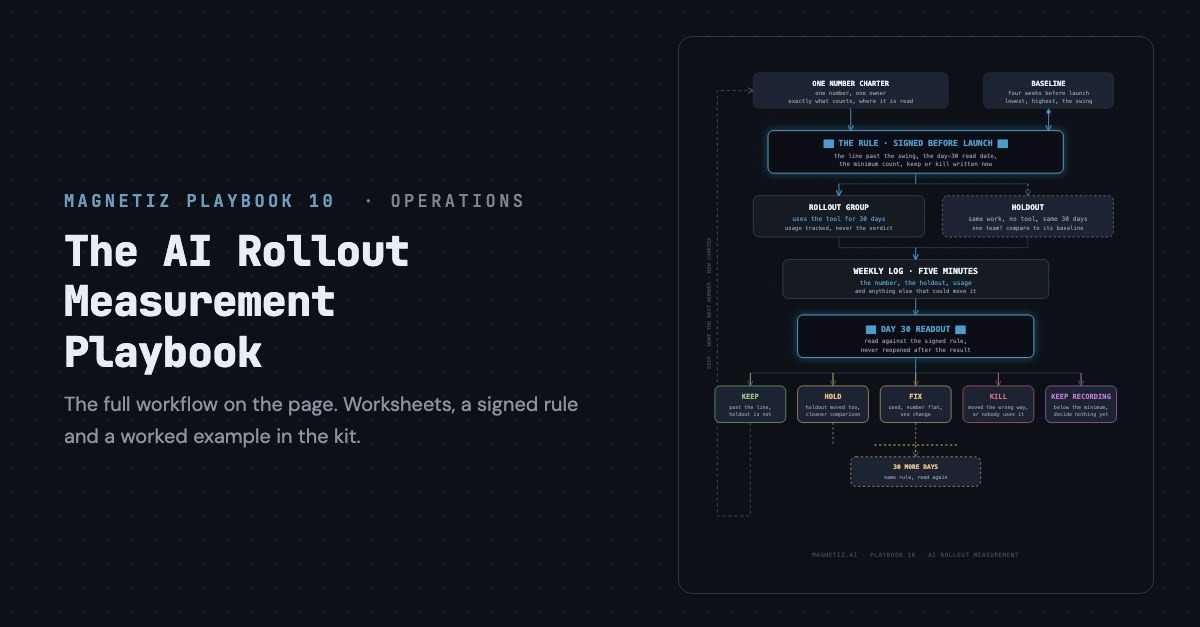
The method needs one owner, a spreadsheet and about five minutes a week. Below is each step with the worked example from the kit. The rollout in the example is an assistant that drafts a research brief before every first sales call. The company and the numbers are made up for illustration.
1. Name the one number the rollout is for
Pick the result the owner of the number already answers for. Write exactly what counts and where it is read from, so two people get the same count.
Then track one usage number beside it, so the readout can tell "not used" apart from "used and changed nothing."
In the example, the number is first calls that turn into a second meeting, per week, owned by the VP of Sales. A second meeting counts if it is held within 21 days of the first call. Internal meetings and reschedules do not count. The usage number is the share of first calls that had a brief opened beforehand.
2. Measure four weeks before
Read the number the same way for the four weeks before launch, and keep the lowest and the highest week. The gap between them is how much the number moves with no tool at all.
In the example, the four weeks read 14, 11, 16 and 13. The low week was the one a rep was out. The swing runs from 11 to 16.
3. Write what counts as moved, and sign it
Set the line past the baseline’s swing, in the direction the number should go. Set the read date at launch plus 30 days, and a minimum count below which the result is too thin to call.
Then write the keep, fix or kill rule. The owner of the number and the owner of the rollout both sign it before launch, while nobody has a stake in the result.
In the example, the line is above 16 a week in two of the last three weeks, with at least 40 first calls in the 30 days.
4. Run it beside a holdout
The strongest comparison is a team, segment or region that does the same work without the tool for the same 30 days. With only one team, compare it against its own baseline. Either way, list anything else planned that could move the number.
In the example, the EMEA team keeps its current prep as the holdout. A new outbound campaign starts in week 2, and it is logged for both teams.
5. Log it every week
One row a week, about five minutes. The number, the holdout’s number, usage, whether it is past the line, and anything from the "what else" list that happened.
6. Read it on day 30 against the signed rule
The rule was written before anyone knew the result, so the readout applies it instead of reopening it. There are five possible outcomes.
- Keep when the number is past the line and the holdout is not.
- Hold for 30 more days with a cleaner comparison when the holdout moved too.
- Fix it with one change when the tool was used and the number stayed flat.
- Fix adoption or kill it when the tool was barely used.
- Keep recording when the count is below the minimum.
In the example, the team landed above 16 in two of the last three weeks, at 18 and 19. The EMEA holdout stayed inside its own range. The campaign ran for both teams, so it cannot explain the gap. Usage was 80% of first calls. The signed rule says keep.
7. Record the decision and start the next charter
Both owners sign the readout. A kept tool names the next number it should move and gets a new charter.
In the example, the next number is the rate at which second meetings turn into opportunities.
Why the order matters
None of these steps is hard on its own. What makes them work is when they happen. The definition, the baseline, the line and the rule all exist before launch, while the answer is still unknown to everyone.
On day 30 the team reads a result against a rule it already agreed to, and the conversation is short.
Get the kit
The kit holds the one number charter with a check that the number is a result and not usage, the four-week baseline log, the rollout rule, the weekly log, the day 30 readout and the filled-in example above.
Six markdown files and the playbook PDF, free by email from the playbook page.
Start with the sample. Then write your own charter and rule before anyone touches the tool. If the owner of the number signs both, the setup is working.
Get the playbook and the kit →
One moved number earns the next test, never a pass for life.